


TME-Based Patient Stratification TME-Based Patient Stratification

TME-Based Patient Stratification

By integrating patient-derived single-cell omics, spatial omics, and clinical phenotype data, we decode cellular heterogeneity in the tumor microenvironment (TME). The result: patient subgroups with distinct biological signatures, and a foundation for stratification, biomarker discovery, and clinical research.

The Challenge

Core Architecture

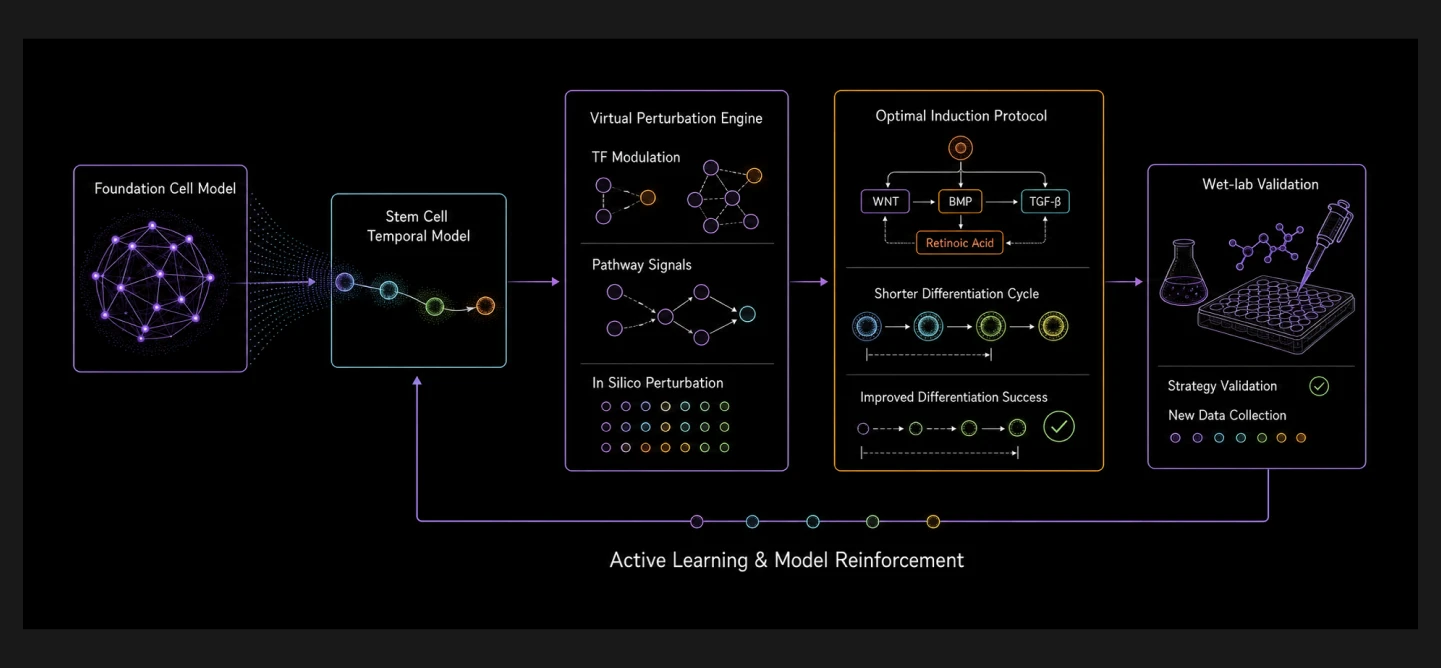
We build a temporal digital twin of stem cells on the CellOS foundation model and use a dual-layer virtual perturbation engine to simulate combinations of signaling pathways at high throughput, automatically outputting the optimal induction process. After wet-lab validation, real-world data flows back into the model for active learning, forming an end-to-end closed loop of simulation, process output, physical validation, and model self-optimization—transforming stem cell differentiation R&D with AIVC's integration of the virtual and the physical.

Core Architecture

R&D Deliverables

Start from tumor microenvironment states to narrow the candidate target space

01
Tumor Ecosystem Mapping

Tumor Ecosystem Mapping

Built on the CellOS foundation model, fully simulating cell differentiation state changes across multiple time points to accurately reproduce the dynamics of cell development.

02
Virtual Perturbation Prediction

Virtual Perturbation Prediction

Simulate different combinations of transcription factors, signaling pathways, and culture conditions to compare their potential effects on cell fate and target phenotypes.

03
Induction Protocol Screening

Induction Protocol Screening

Evaluate and rank candidate conditions in silico to deliver higher-potential validation plans for wet-lab testing.

04
Iterative Biomarker Validation

Iterative Biomarker Validation

Assess the stability, interpretability, and generalizability of candidate stratification features using independent cohorts, retrospective data, and experimental validation where needed.

Core Value

See Inside Tumor Heterogeneity

Form Stratification Hypotheses

Screen Candidate Biomarkers

Support Translational Study Design

Let the next breakthrough begin with AIVC.