






Cell State Annotation
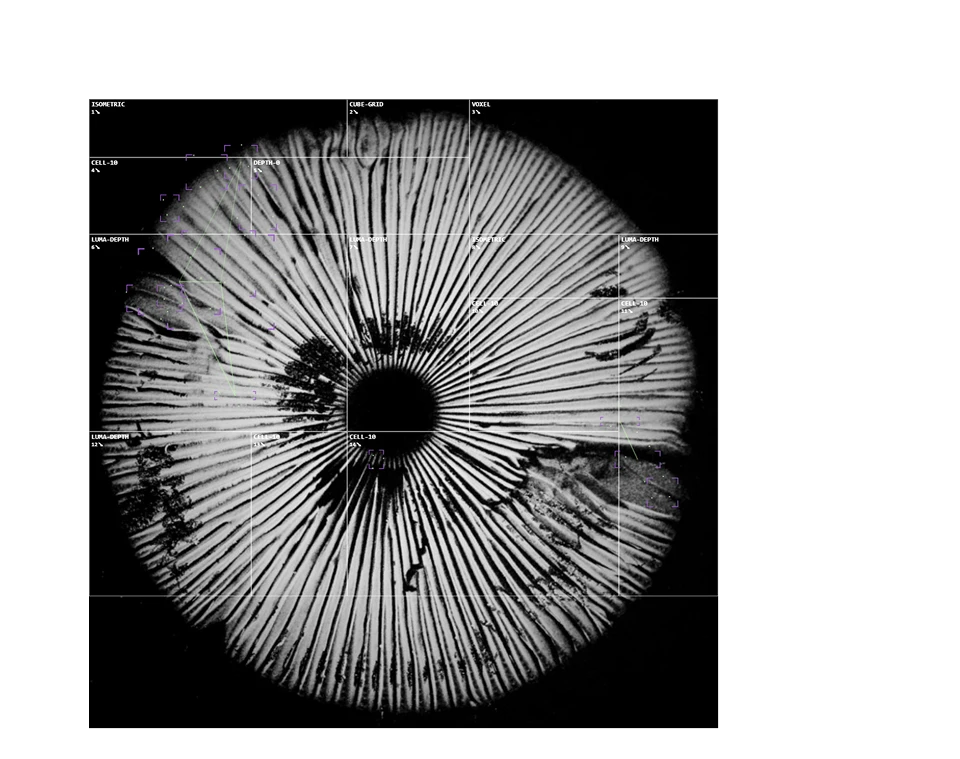
CellOS Foundation Model
CellOS is a 12B-parameter model trained on 390.5 million human single-cell transcriptomes—the world's largest single-cell foundation model to date and the human single-cell model with the most parameters.
Overview
CellOS Embedding (CE) Representation Model: Understanding Life
CellOS Embedding learns high-dimensional latent representations of cells, integrating biological data from different sources, modalities, and batches into a unified feature space. It captures cell states, developmental trajectories, and molecular regulatory principles, providing a stable, generalizable foundation for cell type identification, state analysis, cross-dataset transfer, and downstream predictive models.
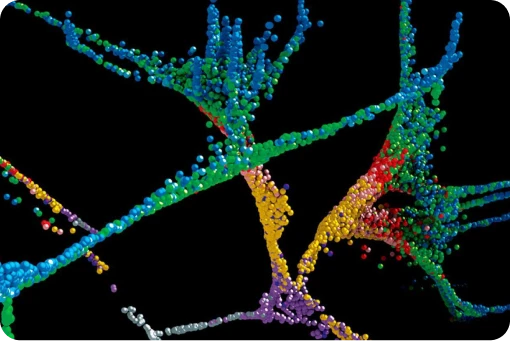
CellOS Transition (CT) Perturbation Model: Predicting Life
Traditional single-cell analysis mainly describes the cell states observed at the end of an experiment. CellOS Transition goes further by learning the relationship between cell states before and after perturbation, extending cell research from “identifying the current state” to “predicting future states.” By integrating cell type, baseline expression state, perturbation conditions, and biological context, the model simulates intervention-induced state transitions in the cell representation space, providing a computational basis for perturbation experiment design, mechanism-of-action studies, and candidate screening.
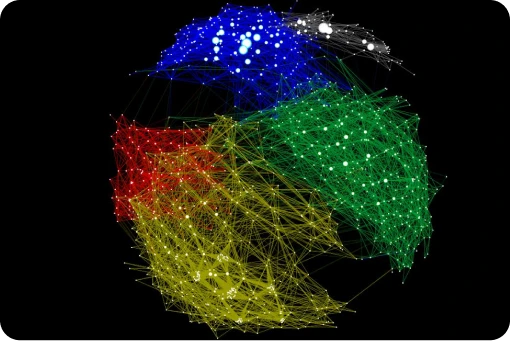
Technical Architecture
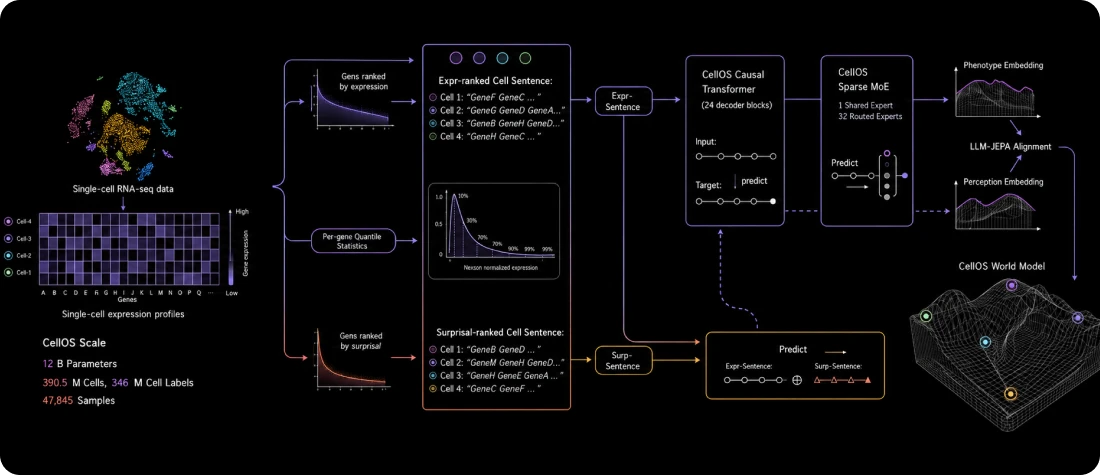
CellOS combines an expression view with a population-relative perception view to learn richer cell-state representations in a unified latent space, delivering stronger generalization and predictive power
 World Model Architecture
 Multimodal
Performance (SOTA)
Macro-F1
1.0
0.5
0.0
0.78
CellOs
0.72
scGPT
0.68
Geneformer
0.64
SCG
0.62
scFoundation
Batch Integration
KBET
1.0
0.5
0.0
0.89
CellOs
0.82
scGPT
0.80
Harmony
0.76
Scanorama
Perturbation Response Prediction
DE Spearman

0.71
CellOs
0.60
BesPv
DE Spearman
0.42
CellOs
0.58
BesPv
DE Dir. Matching
0.73
CellOs
0.61
BesPv
Key Highlights
1
Cell World Model
Learns cell states and dynamics, working toward a unified model for understanding and predicting living systems.
2
Multimodal Representation of Life
Integrates multi-omics and multi-scale information into a unified cross-modal representation of life.
3
Causal Cell Dynamics
Combines time-series observations with perturbation evidence to uncover the causal mechanisms driving cell state changes.
4
Cellular Response Simulation
Goes beyond static cell type identification to predict cellular responses to genetic perturbation, drug intervention, and environmental change.
