








Core Research Areas

Largest Virtual Cell Model

A closed loop from data to prediction
How Does CellAura Work?
How Research Tasks Get Done

1. Ask a Question
Describe your scientific question and goals in natural language


2. Intelligent Understanding
Understand research intent
Break down the task

3. Simulation & Prediction
Call CellOS models
Simulate how the living system responds

4. Result Integration
Integrate analysis results
Generate research insights

5. Scientific Discovery
Deliver conclusions and recommendations
Guide experimental decisions
CellOS Intelligence Engine:A three-tier model system that drives research forward

01 Foundation Model
CellOSPre-trained on large-scale multimodal single-cell data to understand cell states and the language of life.


02 General Perturbation Model
CellOS.PertLearns how cells respond to diverse perturbations and predicts the resulting state changes and trends.


03 Domain-Specific Custom Models
CellOS.TurboDelivers higher-precision prediction and analysis for specific diseases, cell types, and research scenarios.

Immune Cells
Auralmmune

Tumors & Microenvironment
AuraOnco

Engineered Cells
AuraSynth

Drug Discovery & Development
AuraDev
More Domain Models
Continuously Expanding
Less Time on Tools, More Time on Science
Before
Researchers adapt to tools

Researchers


Python

R

Scapy

Seurat

Cell Ranger

Fragmented Tools

Steep Learning Curve

Low Efficiency

High Cost of Trial and Error

Now
Tools adapt to researchers

Scientific Questions

CellAura Agent Platform

Multimodal Data
Single-cell | Spatial multicellular biology | Wenmo knowledge | Experimental data

Biological Knowledge Base
Pathways | Regulatory networks | Cell types | Literature
CellOS Model Engine
Simulate before you experiment.

Cell State Analysis

Perturbation Response Prediction

Experimental Strategy Recommendations

Iterative Model–Experiment Loop

Gain insights faster, reduce trial-and-error costs, and accelerate scientific discovery and innovation.

Natural Language Interaction
Start with a Question
Zero Learning Curve

Autonomous Research Task Orchestration
Automated planning and execution,
so researchers can focus on scientific thinking

Powered by Virtual Cell Models
Narrow the experimental search space through simulation,
reducing experimental costs

Closed-Loop Iterative Optimization
Data and models keep evolving
Results keep accumulating
Core Capabilities
Every research decision is backed by an AI agent and virtual cell models
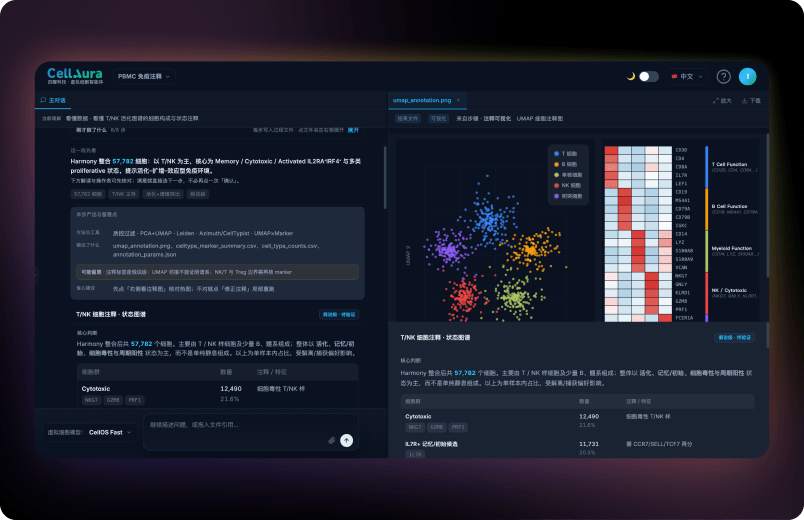
From raw data to cell states: the agent orchestrates the complete analysis pipeline
Describe your analysis goals in natural language, and the agent automatically plans and invokes quality control, integration, clustering, annotation, differential expression, enrichment, and more—turning raw single-cell data into an interactive cell atlas with structured interpretation. These results can be used on their own to understand your data, or serve as a shared starting point for subsequent virtual perturbation.

Cell type/state annotation and composition interpretation

Differential gene expression and pathway enrichment analysis

Interactive side-by-side review of UMAPs, marker heatmaps, and more

The agent orchestrates multiple bioinformatics skills per task, with a fully traceable process
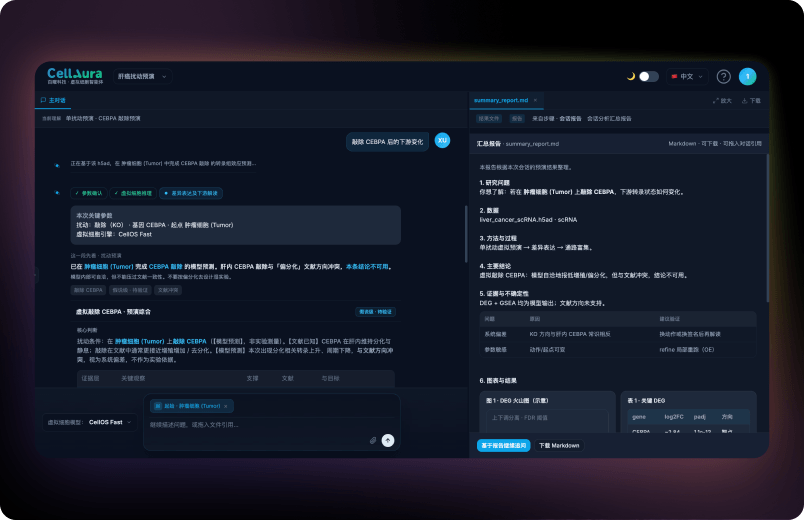
Lock in the starting cell state and run reproducible gene perturbation simulations
On annotated cell states, specify genes to knock down or knock out, or request perturbation recommendations based on a target phenotype. Our proprietary virtual cell engine produces interpretable predictions of downstream transcriptional and functional effects. Every simulation records its parameters and model version, and conclusions are labeled as hypothesis-grade to inform subsequent study design and wet-lab validation.
Simulate knockdown/knockout (KD/KO) of specified genes
Intent-driven perturbation recommendations (candidate ranking with mechanistic interpretation)
Differential genes, pathways, and functional impacts presented side by side
Traceable simulation parameters and engine versions; conclusions are hypothesis-grade, pending validation
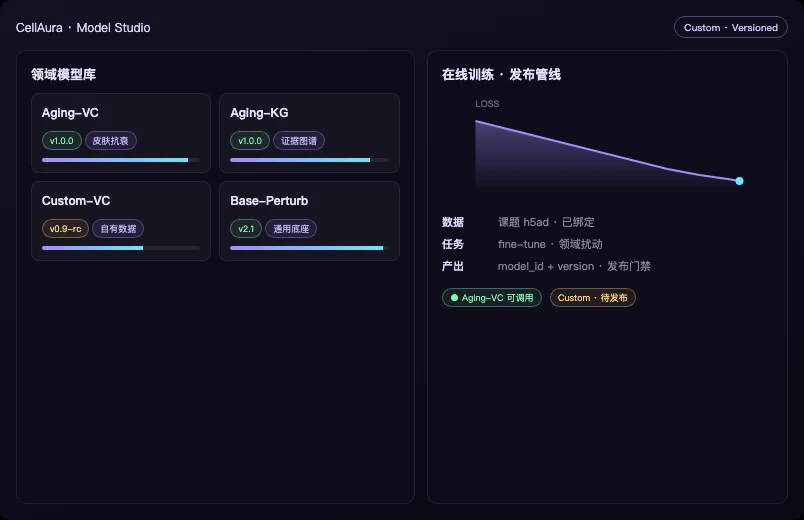
Integrate vertical models and train on your own data
On top of the general perturbation foundation, plug in vertical models such as Aging-VC and Aging-KG, or launch online training and iteration on your project's own data to produce versioned, uniquely identified domain endpoints. Within a session, the agent calls published models as the scenario requires, so predictions for skin anti-aging and other specialized projects are built on auditable model assets.
Plug in vertical virtual cell models by project (anti-aging first, extensible to other areas)
Train or fine-tune online on your own data to improve perturbation performance in your domain
Model IDs and versions that can be called, compared, and audited
Domain knowledge enhancement (e.g., Aging-KG), with evidence and inference presented separately
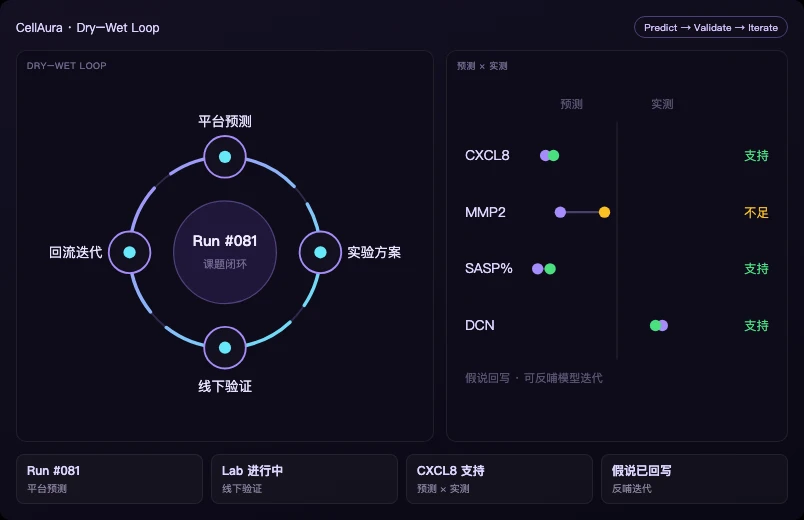
Platform prediction → offline validation → results fed back, driving the next iteration
Once virtual predictions yield candidates, the system drafts an executable experimental protocol (controls, endpoints, and linked prediction records) and coordinates offline validation with partner labs. When measured data comes back, it is compared item by item against predictions; hypothesis status is written back to project memory and can inform the model and the next round of design.
Experimental protocols linked to platform prediction records
Offline task submission, progress tracking, and result collection
Item-by-item comparison of predictions vs. measurements, labeled as supported, inconclusive, or refuted
Hypotheses written back and cases archived to inform the model and the next round of decisions
Applications
From basic research to industrial translation, covering the core areas of cell biology